
• Home
  • Latest
  • Fortune 500
  • Finance
  • Tech
  • Leadership
  • Lifestyle
  • Rankings
  • Multimedia
AIData centers

Moody’s flags $662 billion risk at the heart of the data center build-out by just 5 companies

Nick Lichtenberg
By
Nick Lichtenberg
Nick Lichtenberg
Business Editor
Down Arrow Button Icon
Nick Lichtenberg
By
Nick Lichtenberg
Nick Lichtenberg
Business Editor
Down Arrow Button Icon
February 25, 2026, 3:10 AM ET
data center
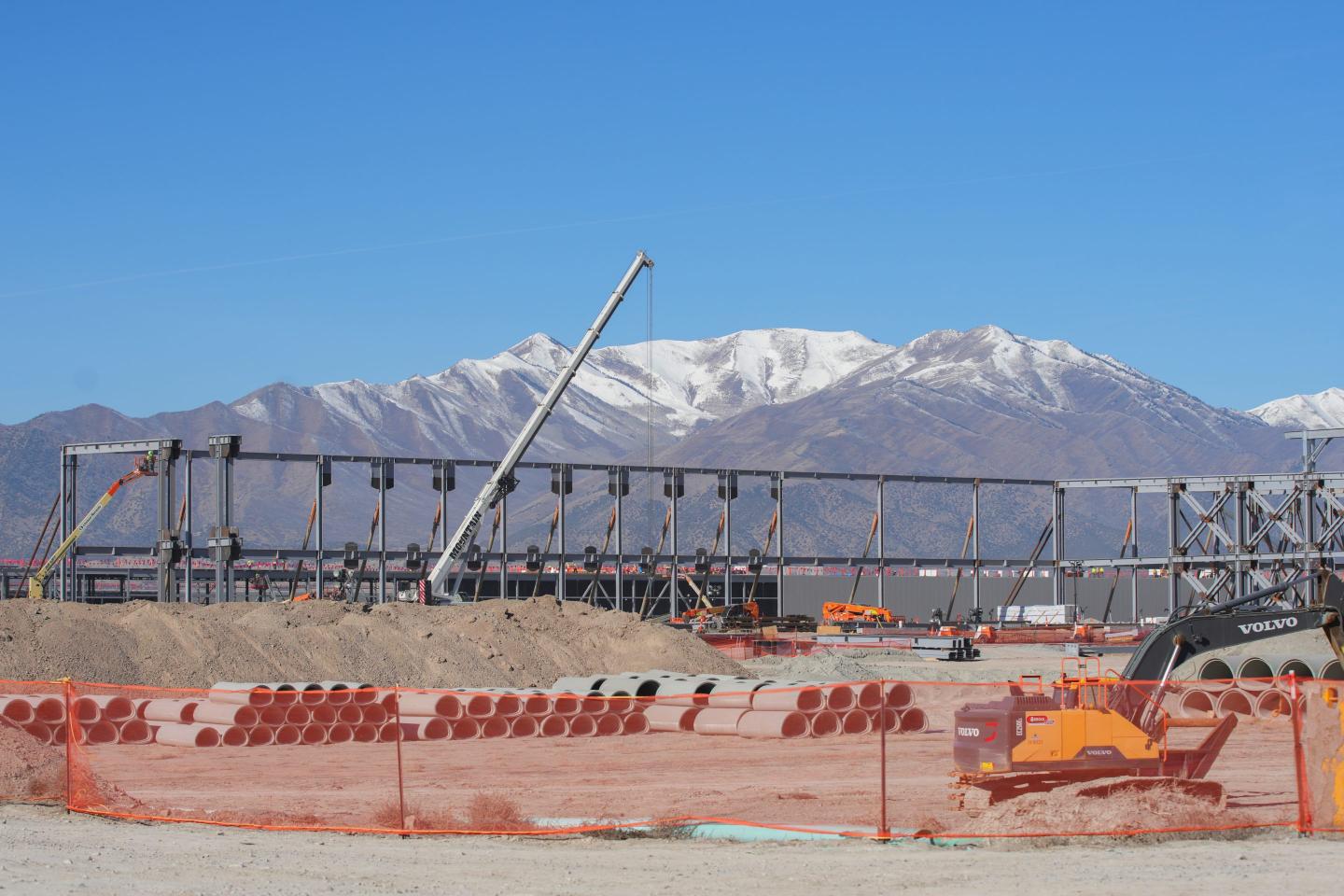
A building under construction at the new QTS Eagle Mountain data center in Utah, Jan. 27, 2026. George Frey—Bloomberg/Getty Images

The technology sector’s frantic race to build artificial intelligence infrastructure has created a massive, financial overhang. According to a recent in-depth report by Moody’s Ratings, the top five U.S. hyperscalers have accumulated $662 billion in future data center lease commitments not yet begun that are not current liabilities and therefore sit entirely off their balance sheets. As those leases begin over the next several years, and as landlords’ obligations are fulfilled, that more than half a trillion dollars’ worth of data center activity will be recorded on balance sheets.

Recommended Video

The report, which analyzed the financial disclosures of Amazon, Meta, Alphabet, Microsoft, and Oracle, highlights how the unprecedented build-out of AI data centers is straining traditional accounting metrics. As of the end of 2025, these five tech giants had amassed a staggering $969 billion in total undiscounted future lease commitments, or data centers that have yet to be built. However, more than two-thirds of this total, that $662 billion figure, is for leases that have yet to commence, meaning that under generally accepted accounting principles, or GAAP, these companies are not required to recognize these massive obligations on their current balance sheets.
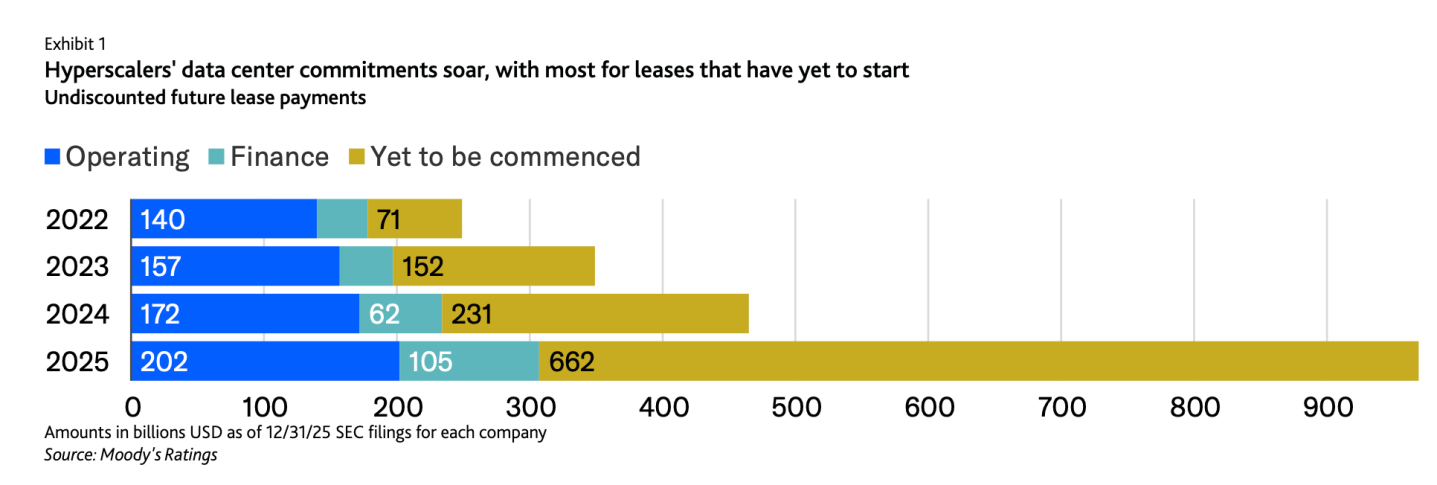
To put the scale of this hidden obligation into perspective, Moody’s accounting analysts David Gonzales and Alastair Drake calculated that the unrecorded $662 billion is equivalent to 113% of these five hyperscalers’ most recent adjusted debt.

Gonzales told Fortune in a statement that it’s “not as if [these hyperscalers] have have avoided a liability through structuring,” characterizing the $662 billion at issue as “yet to be on the balance sheet,” rather than missing. “More accurately,” he added, “they have not yet received the services to trigger this liability as of this time, but they will.”

For instance, Alphabet disclosed in a footnote in the third quarter of 2025 that it had “entered into leases primarily related to data centers that have not yet commenced with future lease payments of $42.6 billion, including a purchase option considered reasonably certain to be exercised, that are not yet recorded on our Consolidated Balance Sheet. These leases will commence between 2025 and 2031 with noncancelable lease terms between one and 25 years.”

That came after a Q2 disclosure stating Alphabet had “entered into leases primarily related to data centers that have not yet commenced with future lease payments of $23.9 billion, that are not yet recorded on our Consolidated Balance Sheets. These leases will commence between 2025 and 2031 with noncancelable lease terms between one and 25 years.”

From the second to the third quarter, future lease payments, an unrecorded future obligation, jumped from $23.9 billion to $42.6 billion.

Meta, Amazon, and Microsoft declined to comment. Alphabet and Oracle did not respond to requests for comment.

What is going on with these leases?

The root of this accounting phenomenon lies in the unique nature of AI hardware and the rules governing corporate leases. Historically, U.S. data center leases spanned 10 to 15 years. But because the cutting-edge semiconductor and technology equipment required for AI typically has a useful life of just four to six years, hyperscalers are demanding shorter initial lease terms with options to renew. And “to make the investment case for landlords,” the note explains, “these structures are often backstopped by a significant off-balance-sheet guarantee from the lessee.”

Under GAAP, a lease renewal period is only included in a company’s lease liability if the renewal is deemed “reasonably certain”—a high threshold requiring greater than 70% certainty. (GAAP emerged in the 1930s as a response to the 1929 stock market crash that coincided with, even caused, the onset of the Great Depression.) Because future AI strategies and technology upgrades are highly unpredictable, tech giants can justifiably argue that they are not reasonably certain to renew, thereby keeping the potential renewal costs off their books.

But landlords still require financial security to construct these specialized, multibillion-dollar facilities. To bridge this gap, hyperscalers are utilizing significant off-balance-sheet guarantees, most notably “residual value guarantees” (RVGs). An RVG acts as a backstop; if a tech company cancels or does not renew a lease, it must pay the landlord the difference if the data center’s market value falls below a pre-agreed threshold.

Crucially, U.S. GAAP allow companies to defer reporting these expected RVG obligations. Unless it is deemed “probable” that the lease will end without renewal, the contingent liability of the RVG does not need to be recorded on the balance sheet. Moody’s notes that “if a company concludes a lease renewal is likely to be exercised, but not reasonably certain, it can avoid classifying both the lease renewal periods and the residual value guarantee as liabilities.”

Meta Platforms provides a striking example of this practice. In its recent SEC filings, Meta disclosed entering into data center leases commencing in 2029 with an initial commitment of approximately $12.3 billion. Alongside this, Meta provided an RVG with a massive aggregate threshold of $28 billion. Because Meta deemed the RVG payouts “not probable,” no liability was recorded for this $28 billion guarantee.

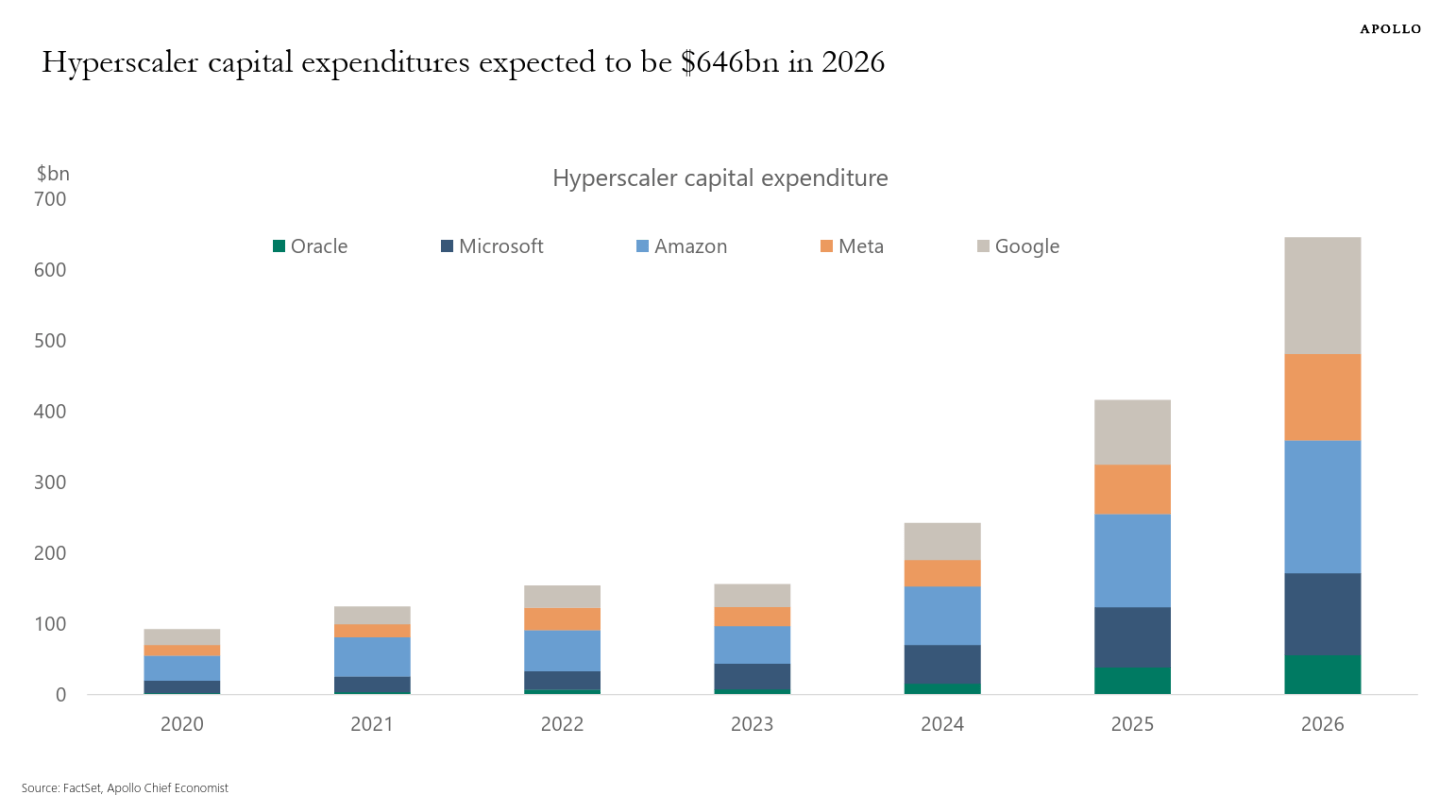
In a chart book published nearly simultaneously with Moody’s report, Apollo Global Management chief economist Torsten Slok worked to put the enormity of data center spending into perspective. With total capital expenditure on data centers estimated at roughly $646 billion, or about 2% of U.S. GDP, Slok noted that is roughly equivalent to the GDP for Singapore, Sweden, and Argentina. Defense spending in 2025, meanwhile, was around $917 billion.
Moody’s warned that these opaque accounting practices mask the true economic risk facing the tech industry. While leasing reduces upfront capital investments, carrying such massive future commitments severely limits a company’s financial and operating flexibility, especially if AI industry conditions change rapidly. Because these liabilities are hidden, Moody’s concluded, in its own jargony way, that it is considering new ways to look at this issue.

“The accounting liability is unlikely to reflect certain plausible future scenarios … With this in mind, we will continue to assess cash exposures and debt-like adjustments as time progresses and the dates of new leases draw nearer. We may make a nonstandard adjustment to Moody’s adjusted debt based on our expectation of likely cash outflows.”

Join us at the Fortune Workplace Innovation Summit May 19–20, 2026, in Atlanta. The next era of workplace innovation is here—and the old playbook is being rewritten. At this exclusive, high-energy event, the world’s most innovative leaders will convene to explore how AI, humanity, and strategy converge to redefine, again, the future of work. Register now.
About the Author
Nick Lichtenberg
By Nick LichtenbergBusiness Editor
LinkedIn icon

Nick Lichtenberg is business editor and was formerly Fortune's executive editor of global news.

See full bioRight Arrow Button Icon

Latest in AI

Finance
Lorem ipsum dolor sit amet, consectetur adipiscing elit, sed do eiusmod tempor incididunt ut labore et dolore magna aliqua. Ut enim ad minim veniam
By Fortune Editors
October 20, 2025
Finance
Lorem ipsum dolor sit amet, consectetur adipiscing elit, sed do eiusmod tempor incididunt ut labore et dolore magna aliqua. Ut enim ad minim veniam
By Fortune Editors
October 20, 2025
Finance
Lorem ipsum dolor sit amet, consectetur adipiscing elit, sed do eiusmod tempor incididunt ut labore et dolore magna aliqua. Ut enim ad minim veniam
By Fortune Editors
October 20, 2025
Finance
Lorem ipsum dolor sit amet, consectetur adipiscing elit, sed do eiusmod tempor incididunt ut labore et dolore magna aliqua. Ut enim ad minim veniam
By Fortune Editors
October 20, 2025
Finance
Lorem ipsum dolor sit amet, consectetur adipiscing elit, sed do eiusmod tempor incididunt ut labore et dolore magna aliqua. Ut enim ad minim veniam
By Fortune Editors
October 20, 2025
Finance
Lorem ipsum dolor sit amet, consectetur adipiscing elit, sed do eiusmod tempor incididunt ut labore et dolore magna aliqua. Ut enim ad minim veniam
By Fortune Editors
October 20, 2025

Most Popular

Finance
Lorem ipsum dolor sit amet, consectetur adipiscing elit, sed do eiusmod tempor incididunt ut labore et dolore magna aliqua. Ut enim ad minim veniam
By Fortune Editors
October 20, 2025
Finance
Lorem ipsum dolor sit amet, consectetur adipiscing elit, sed do eiusmod tempor incididunt ut labore et dolore magna aliqua. Ut enim ad minim veniam
By Fortune Editors
October 20, 2025
Finance
Lorem ipsum dolor sit amet, consectetur adipiscing elit, sed do eiusmod tempor incididunt ut labore et dolore magna aliqua. Ut enim ad minim veniam
By Fortune Editors
October 20, 2025
Finance
Lorem ipsum dolor sit amet, consectetur adipiscing elit, sed do eiusmod tempor incididunt ut labore et dolore magna aliqua. Ut enim ad minim veniam
By Fortune Editors
October 20, 2025
Finance
Lorem ipsum dolor sit amet, consectetur adipiscing elit, sed do eiusmod tempor incididunt ut labore et dolore magna aliqua. Ut enim ad minim veniam
By Fortune Editors
October 20, 2025
Finance
Lorem ipsum dolor sit amet, consectetur adipiscing elit, sed do eiusmod tempor incididunt ut labore et dolore magna aliqua. Ut enim ad minim veniam
By Fortune Editors
October 20, 2025
Fortune Secondary Logo
Rankings
  • 100 Best Companies
  • Fortune 500
  • Global 500
  • Fortune 500 Europe
  • Most Powerful Women
  • Future 50
  • World’s Most Admired Companies
  • See All Rankings
Sections
  • Finance
  • Fortune Crypto
  • Features
  • Leadership
  • Health
  • Commentary
  • Success
  • Retail
  • Mpw
  • Tech
  • Lifestyle
  • CEO Initiative
  • Asia
  • Politics
  • Conferences
  • Europe
  • Newsletters
  • Personal Finance
  • Environment
  • Magazine
  • Education
Customer Support
  • Frequently Asked Questions
  • Customer Service Portal
  • Privacy Policy
  • Terms Of Use
  • Single Issues For Purchase
  • International Print
Commercial Services
  • Advertising
  • Fortune Brand Studio
  • Fortune Analytics
  • Fortune Conferences
  • Business Development
About Us
  • About Us
  • Editorial Calendar
  • Press Center
  • Work At Fortune
  • Diversity And Inclusion
  • Terms And Conditions
  • Site Map
Fortune Secondary Logo
  • About Us
  • Editorial Calendar
  • Press Center
  • Work At Fortune
  • Diversity And Inclusion
  • Terms And Conditions
  • Site Map
  • Facebook icon
  • Twitter icon
  • LinkedIn icon
  • Instagram icon
  • Pinterest icon

Latest in AI

greenspan
EconomyFederal Reserve
’90s nostalgia seizes the Fed and White House as Warsh and Trump see AI as an internet-style productivity boom
By Paul Wiseman and The Associated PressMarch 2, 2026
2 hours ago
washington
LawWashington
Washington roasted for using AI feature with heavily accented English instead of actual Spanish on state helpline
By Cedar Attanasio and The Associated PressMarch 2, 2026
2 hours ago
Europedigital transformation
Why Europe can lead in trusted, industrialized AI
By Dave McCannMarch 2, 2026
3 hours ago
Electrician apprentices at work.
Future of WorkCareers
A dire electrician shortage is a ‘life-or-death’ threat to the AI data center boom—and an opportunity for Gen Z
By Preston ForeMarch 2, 2026
7 hours ago
Two girls look at a white laptop placed on a desk.
AIEducation
American schools weren’t broken until Silicon Valley used a lie to convince them they were—now reading and math scores are plummeting
By Sasha RogelbergMarch 1, 2026
19 hours ago
U.S. President Donald Trump delivers the State of the Union address during a joint session of Congress in the House Chamber at the Capitol on February 24, 2026 in Washington, D.C.
EnergyData centers
Your utility bills keep going up. Here’s everyone you can blame—AI data centers included
By Jordan BlumMarch 1, 2026
1 day ago

Most Popular

placeholder alt text
Economy
Your grandparents are the reason the U.S. isn't in a recession right now. That won't last forever
By Eleanor PringleMarch 1, 2026
1 day ago
placeholder alt text
Success
MacKenzie Scott's close relationship with Toni Morrison long before Amazon put her on the path give more than $1 billion to HBCUs
By Sasha RogelbergMarch 1, 2026
23 hours ago
placeholder alt text
Middle East
U.S. military gives Iran a taste of its own medicine with cheap copycat Shahed drones, while concern shifts to munitions supply in extended conflict
By Jason MaMarch 1, 2026
19 hours ago
placeholder alt text
Middle East
As Iran attacks Dubai, the tax-free haven for the global elite could see 'catastrophic' fallout — 'this can also send shockwaves globally'
By Jason MaMarch 1, 2026
21 hours ago
placeholder alt text
Health
Gen Z men are eating ‘boy kibble,’ the human equivalent to dog food, to load up on protein cheaply
By Jake AngeloMarch 1, 2026
1 day ago
placeholder alt text
AI
American schools weren’t broken until Silicon Valley used a lie to convince them they were—now reading and math scores are plummeting
By Sasha RogelbergMarch 1, 2026
19 hours ago

© 2026 Fortune Media IP Limited. All Rights Reserved. Use of this site constitutes acceptance of our Terms of Use and Privacy Policy | CA Notice at Collection and Privacy Notice | Do Not Sell/Share My Personal Information
FORTUNE is a trademark of Fortune Media IP Limited, registered in the U.S. and other countries. FORTUNE may receive compensation for some links to products and services on this website. Offers may be subject to change without notice.